About
Our Mission
CellPhe is a pioneering research initiative at the intersection of biology and computational science, committed to uncovering the rules of life through the lens of temporal cellular dynamics. While traditional biological methods often rely on static snapshots or endpoint assays that miss the continuous shifts in cell behaviour, our work focuses on the “dynamic phenotype.” We aim to bridge the gap between high-volume imaging and actionable data by providing an unbiased, automated framework to characterize how individual cells move, grow, and interact over time. By capturing the full trajectory of a cell’s life, we can better understand the fundamental mechanisms governing health and disease.

Technology and Methodology
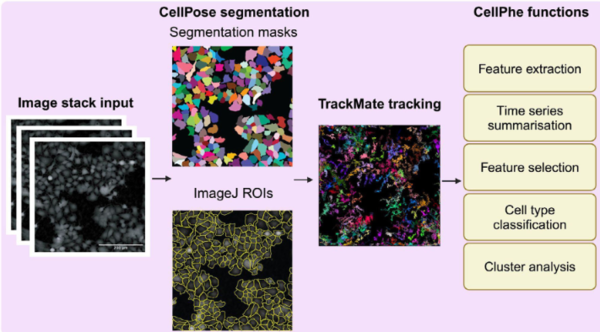
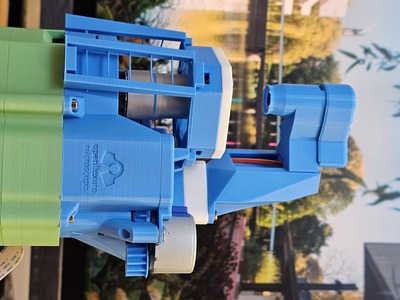
The project’s core methodology integrates advanced time-lapse microscopy with high-dimensional data analysis. We utilize various imaging modalities, including innovative adaptations of the OpenFlexure Microscope for affordable, accessible live-cell tracking. Once high-resolution timelapses of cells are captured, our specialized software automatically extracts over 70 quantitative features from every tracked cell, ranging from texture and density to complex kinetic patterns. These datasets are then processed using ensemble classification and clustering algorithms to predict cell fate and identify subtle shifts in cellular state that would be invisible to the human eye. To ensure these tools are available to the global scientific community, we have developed and maintained the open-source CellPhe R Package and a Python Package counterpart.
Research Applications
Our research has wide-ranging applications in modern medicine, with a particular focus on the most pressing challenges in oncology. By applying automated phenotyping to the study of cancer dormancy, we are working to predict when dormant breast cancer cells might reactivate, potentially identifying new windows for therapeutic intervention before a clinical relapse occurs. Furthermore, the CellPhe framework is used to examine complex interactions between cancer cells and their surrounding stroma, as well as to identify early morphological signatures of drug resistance. This allows us to decode the cellular heterogeneity that often leads to treatment failure in diverse patient populations. Furthermore, we have used CellPhe to study the phenomics of primary macrophages infected with Leishmania, and the effect of a Tau mutation in an Alzheimer’s model. There is diverse potential for CellPhe to be used to answer many research questions across a broad spectrum of biological disciplines.
Core Team @ York
Successes and Support
The impact of the CellPhe project is reflected in our publications in scientific journals such as Nature Communications and the Journal of Microscopy. Our ongoing research into cellular dynamics and machine learning is made possible through the generous support of funding bodies, including the Biotechnology and Biological Sciences Research Council (BBSRC) and the Wellcome Trust. Together, we are building a standardized framework for the future of cytological discovery.